

Why families with French ancestry must act now — even when the situation seems secure today. French...
A practical guide for expats, immigration applicants, and those claiming French citizenship by descent — including the misconceptions that lead to unjustified rejections.

Whether you are preparing a long-stay visa, a request for a titre de séjour, a French nationality application by descent, by residence or by marriage, or simply trying to register the birth of a child abroad — sooner or later you will be asked to produce a foreign civil status document in France. And, sooner or later, you will face questions you did not expect: "Is this document still valid?" "Where is the apostille?" "Why is the translation not accepted?"
Behind these everyday questions lies a body of law that is too often misunderstood — not just by applicants, but by the very administrations that handle the files. This article is a synthesis of the rules that actually apply, and of the limits within which French authorities may demand additional formalities. It is intended to be useful across the full range of cases: immigration, French nationality (including citizenship by descent), marriage, and everyday administrative procedures.
1. The legal foundation: Article 47 of the French Civil Code
Everything begins with one provision — Article 47 of the French Civil Code:
Every civil status act of a French national or of a foreign national, drawn up in a foreign country, is given full faith and credit, if it has been drawn up in the forms used in that country, unless other authentic acts or documents held, external data, or elements drawn from the act itself establish, where appropriate after all useful verifications, that this act is irregular, falsified, or that the facts which are declared therein do not correspond to reality.
This is the cornerstone. A foreign civil status act — a birth certificate, a marriage certificate, a death certificate — is presumed valid in France if it has been drawn up in the customary forms of the issuing country. The French administration is not free to reject it on a hunch, a formal pretext, or by imposing requirements that it would not apply to a French act of the same nature. To overturn the presumption, the administration must produce concrete evidence that the act is irregular, forged, or that the facts it states are inaccurate.
This principle is decisive in practice. Many of the rejections expats and citizenship applicants receive are based on internal administrative habits that are not anchored in the law — and that can be successfully challenged.
2. Apostille vs. Legalisation — what is the difference?
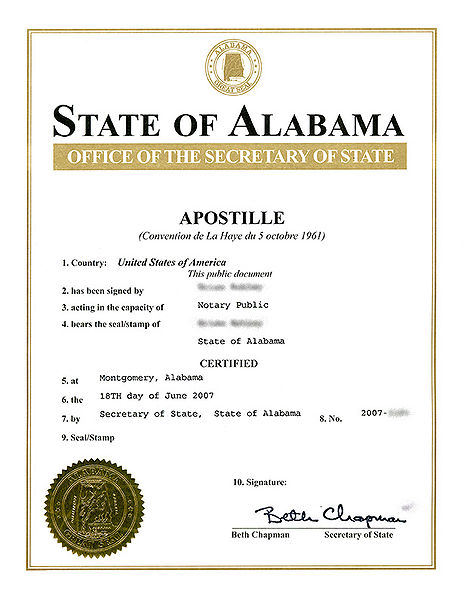
Apostille — the Hague Convention of 5 October 1961
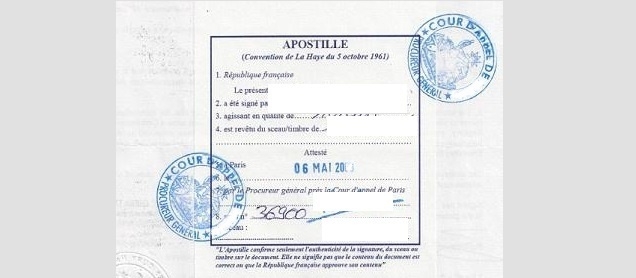
The Hague Apostille Convention of 5 October 1961, to which France is a party, replaces the cumbersome process of consular legalisation with a single, standardised certificate — the apostille. The apostille is affixed by a competent authority of the country where the document was issued, and is automatically recognised in every other member State, including France. Once apostilled, the document is admissible in France without any further formality (subject to translation, see below).
More than 120 countries are party to the Convention — the United States, the United Kingdom, most of Latin America, most of Europe, much of Asia. The procedure is fast and inexpensive in most jurisdictions.
Legalisation (or double legalisation)
For documents issued in countries that are not party to the 1961 Hague Convention, the older route applies: legalisation. The process typically involves two or three steps:
- certification by the competent domestic authority of the country of origin (often a foreign ministry);
- legalisation by the French consulate accredited to that country;
- in some cases, an intermediate step before the foreign affairs ministry of a third country.
This route is slower, costlier, and far more prone to administrative back-and-forth. A French lawyer can map the precise chain required for each country and document type.
3. The conventions that exempt these formalities
Beyond the Hague Convention, France is bound by a network of bilateral and multilateral conventions that exempt certain foreign documents from any formality — not even an apostille. Knowing where these exemptions apply can save weeks of administrative time and substantial cost.
United Kingdom — the 1968 London Convention
The European Convention on the Abolition of Legalisation of Documents executed by Diplomatic Agents or Consular Officers, signed in London on 7 June 1968, exempts British civil status documents from apostille and legalisation when used in France. In practice, this means that a British birth certificate issued by the General Register Office (GRO) can be submitted directly to French authorities in a French nationality application, without any additional formality. The same principle applies symmetrically to French documents used in the UK.
This is one of the most overlooked rules in expat files. Many British applicants spend money and time obtaining an apostille from the FCDO — only to learn, too late, that it was unnecessary. For a full strategic overview of the citizenship-by-descent procedure for British and American applicants, see also our complete guide for Americans and British applicants.
European Union — Regulation (EU) 2016/1191
Within the European Union, Regulation (EU) 2016/1191 of 6 July 2016, applicable since February 2019, abolishes the apostille requirement for a wide range of public documents issued by one Member State and presented in another — including civil status acts (birth, marriage, death, parenthood, registered partnership), residence, criminal record certificates, and others. The Regulation also provides a system of multilingual standard forms that, when attached to the original, eliminate the need for a sworn translation in most cases.
Other relevant exemptions
France has bilateral conventions with several other States that fully or partially exempt civil status documents from apostille — including, with varying scopes, conventions with Italy, Germany, Switzerland, Austria, Spain, Portugal, Belgium, the Netherlands, and others. Each must be checked individually before any administrative submission.
4. The myth of the “six-month validity”

If there is one misconception worth dismantling, it is the idea that a foreign birth certificate “is only valid for six months”. This sentence is repeated in countless online forums, by countless administrative agents, and to countless applicants — almost always without legal foundation.
The truth. The six-month rule exists in French law — but it applies only to civil status acts produced in connection with the celebration of a marriage in France. It is anchored in the rules of the code civil on the formation of marriage and in the practice of officiers d'état civil. It does not apply to French nationality applications, immigration files, social security registrations, or to any other administrative procedure.
In every other context, a foreign birth certificate that is properly apostilled or legalised — and translated where required — remains valid indefinitely under Article 47. The administration may only set it aside by producing concrete evidence that it is irregular, forged, or factually inaccurate.
This is more than a technical detail. Where authorities apply the six-month rule outside its proper scope, their decision is unlawful and can be successfully challenged.
5. Document by document — what to ask for
Birth certificates
Always request the long-form version — in France, the copie intégrale; in the UK, the full birth certificate; in the United States, the long-form birth certificate. The long-form contains the parents' full identities and any subsequent annotations (acknowledgement of paternity, name changes, marriage, divorce). The short-form or abbreviated extracts are routinely refused by French authorities — not because the law requires the long-form, but because the file is built around the genealogical chain it contains.
For files involving filiation — particularly French nationality by descent (citizenship by descent through a parent or grandparent born in France) — the long-form is indispensable.
Marriage and death certificates
Same logic. Request the long-form, with all marginal annotations. For marriage acts, this includes any subsequent divorce or annulment marginal mention — a critical detail in family-reunification, surname-change, or estate files.
Foreign judgments (divorce, adoption, recognition)
Foreign judgments often require an additional step beyond apostille or legalisation: recognition in France, either automatic (for EU judgments under specific regulations) or via an exequatur procedure for the rest. A foreign divorce decree, for example, may need to be transcribed into French civil registers before it can be used to remarry in France or to file for nationality.
6. Why the same document may be required — or exempted — depending on the procedure

A recurring source of confusion is that the same foreign document may be admitted by one French authority and rejected by another — on the same day, in the same town. The reason is simple: each procedure has its own internal practice, and even within the same procedure, different agents apply different standards.
A British birth certificate sent to the tribunal judiciaire for a CNF application (Certificat de Nationalité Française) will normally be accepted without apostille, thanks to the 1968 Convention. The same certificate, sent to a French consulate abroad for a passport renewal, may be rejected for lack of apostille — even though the Convention applies equally. In each case, the right response is to know the legal basis, present it courteously to the authority, and escalate where necessary.
Practical tip. Always anticipate that the same document may be needed for several procedures in parallel — nationality, immigration, fiscal, social security. Order two or three originals of each long-form certificate at the outset, and request two or three originals of the apostille where applicable. The cost is marginal; the time saved is considerable.
7. Translations — the silent trap
Once a foreign document has been apostilled or legalised, it almost always needs to be translated into French — and the translation must be produced by a traducteur assermenté registered with a French Cour d’Appel. Translations performed abroad, even by qualified professionals, are generally refused.
The Regulation (EU) 2016/1191 allows the use of multilingual standard forms attached to certain EU civil status acts, which avoids the need for translation altogether. Where these forms can be obtained, the timeline collapses dramatically.
Order matters. Always have the document apostilled or legalised first, and only then send it to the sworn translator. The apostille itself must also be translated, and it cannot be added afterwards without a second round of translation.
8. Practical checklist before any French administrative procedure
- Identify the receiving authority (préfecture, consulate, tribunal judiciaire, mairie, CPAM) and its specific document requirements.
- Check whether a convention exempts the document from apostille or legalisation (UK, EU, bilateral conventions).
- Order the long-form certificate, never the short-form.
- Order multiple originals and multiple apostilles where the document will be used in parallel procedures.
- Apostille or legalise first; translate second, using a French traducteur assermenté.
- Keep the originals safe — courts and préfectures may demand them during the file’s lifetime.
- Document the chain — date of issue, date of apostille, date of translation — in case a French authority later contests the timeline.
- When in doubt, seek legal advice — a one-hour consultation often saves months of avoidable delays.
9. Frequently Asked Questions
Is a US birth certificate only valid in France for six months?
No — this is one of the most widespread misconceptions. The six-month rule applies only to acts that will be used to celebrate a marriage in France (or to register a PACS in some cases). For French nationality applications, immigration files, social security registrations, or any other administrative procedure, no such expiry exists. A foreign birth certificate that is properly apostilled or legalised remains valid indefinitely under Article 47 of the French Civil Code, unless and until the French administration produces evidence that it is irregular, falsified or altered.
Do British birth certificates need to be apostilled for a French nationality application?
For French nationality applications, no. The European Convention on the Abolition of Legalisation of Documents executed by Diplomatic Agents or Consular Officers (London, 1968), to which both France and the United Kingdom are parties, exempts British civil status documents from apostille and legalisation when used in France. Civil status acts issued in the UK by the General Register Office are accepted directly. Other procedures, however, may still require an apostille if the receiving authority is unaware of the Convention.
Can the same foreign document be accepted in one French procedure and rejected in another?
Yes, and this is a recurring source of frustration. The formal validity requirements depend on the procedure in which the document is being used. A document admitted for a French nationality application may be rejected for a passport renewal at the consulate. The best practice is to confirm, before any submission, the specific requirements of the receiving authority and prepare the file accordingly — including, where useful, multiple originals or certified copies of the apostille.
Can I have a foreign document translated abroad and used in France?
In principle, French authorities require a translation produced by a sworn translator (traducteur assermenté) registered with a French Cour d’Appel. Translations produced abroad — even by qualified translators — are generally not accepted, with limited exceptions for certain bilateral arrangements. The safest approach is to commission the translation in France, after the document has been apostilled or legalised in the country of origin.
What if my country of origin does not issue apostilles?
If the country of origin is not a party to the 1961 Hague Convention, the document must go through the (often longer) legalisation procedure: first by the national authority that issued or certified it, then by the French consulate in the country of origin, or — in some cases — through a double legalisation involving the Ministry of Foreign Affairs of both States. A French lawyer can map the precise chain required for each country and document.
Should I always request the long-form (copie intégrale) of a foreign civil status act?
Yes. French authorities almost invariably require the long-form copy, not the abbreviated extract. The long-form contains the full filiation and any subsequent annotations (marriage, divorce, recognition of paternity, etc.), which are essential in nationality and immigration files. Always request the copie intégrale (or its foreign equivalent — "full birth certificate" in the UK, "long-form birth certificate" in the US) before sending the document for apostille or legalisation.
Article 47 of the Civil Code seems to protect foreign documents — can French authorities still refuse them?
Article 47 creates a presumption of validity in favour of duly executed foreign civil status acts. The French administration may overturn that presumption only by producing concrete evidence that the act is irregular, forged, or that the facts it states are inaccurate. Mere doubt, formal pretexts, or conditions not imposed on French acts of the same nature are not sufficient grounds for rejection. Where authorities exceed these limits, the decision is open to challenge — typically by gracious recourse and, if necessary, before the administrative court.
10. The bottom line
Foreign documents in France are governed by clearer rules than the administrative practice sometimes suggests. The presumption of Article 47, the framework of the Hague Convention, the network of bilateral and EU exemptions, and the specific requirements of each procedure form a coherent system — once it is properly read.
The cost of misreading it is measured in months of delay, in unnecessary travel back to the country of origin, and in rejected applications. The cost of reading it correctly is, in most cases, a single hour of qualified legal advice at the outset of the file.
11. Related reading
If you are preparing a French nationality or immigration file, you may also find these in-depth resources useful:
- French Citizenship by Descent & Dual Nationality — The Complete Guide for Americans and British Applicants — a full procedural roadmap, from documentary chain to the CNF before the tribunal judiciaire de Paris.
- French Citizenship by Descent: Reclaim Your French Heritage Through Your Ancestors — the strategic framework for families with French ancestry seeking to secure dual citizenship across generations.
Preparing a French Nationality, Immigration or Civil Status File?
I assist expats, French citizens abroad, and citizenship-by-descent applicants in navigating French administrative procedures — including the validation of foreign documents and the strategic preparation of nationality files. Procedures conducted entirely at distance, worldwide.
Book a Confidential Consultation