
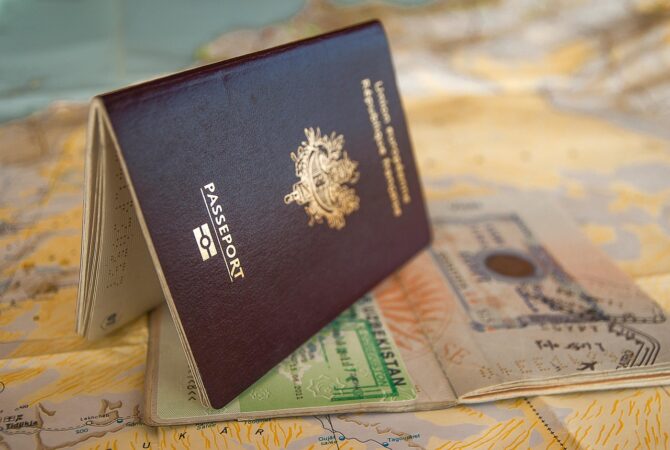
You have held French nationality your entire life. You may have been born in the United States, the...
French Passport Refused? Your Rights When France Challenges Your Nationality
You are French. You have always been French. And yet, when you applied to renew your passport, the consulate or prefecture refused — casting doubt on whether your French nationality is valid at all. This situation is more common than you might think, and the law is firmly on your side.
What Is a "Doute Sérieux" — and Why Does It Matter?
Under French law, the administration has the authority to question the nationality of an applicant before issuing or renewing a passport.
If you don't have a CNF, they can put that in question at any time.
If you had passports or other French docs in the past, the legal standard they must meet is called the doute sérieux — a "serious doubt" about the applicant's nationality.
This concept, rooted in French civil law and consistently confirmed by the courts, is not a vague discretionary power. It is a legal threshold that triggers a set of strict procedural obligations.
The problem is that many consulates and prefectures invoke this concept loosely, informally, or without proper justification — leaving applicants without a passport, without a clear explanation, and without knowing their rights.
Your Passport Was Valid Less Than Five Years Ago? The Bar Is Even Higher.
French jurisprudence has established a particularly strong protection for individuals who held a valid French passport within the past five years. In such cases, the authorities face a significantly higher burden to justify any refusal. The existence of a recent valid passport constitutes strong evidence of a previously recognised nationality, and the administration cannot simply ignore this without confronting it directly in their reasoning.
Courts have consistently annulled refusals where the administration failed to explain why a recently issued passport no longer constituted sufficient proof of nationality. If you fall into this category, this is one of the most powerful arguments available to you.
"The existence of a valid French passport issued less than five years ago creates a presumption in favour of the applicant that the administration must expressly address and rebut." Consistent line of French administrative and civil jurisprudence
The Law Requires a Formal, Written, Reasoned Decision
This is where many refusals are legally vulnerable. A verbal notification, an informal email, or a simple administrative form stating that your file is "under review" or that documents are missing does not constitute a lawful refusal.
When the administration invokes a doute sérieux about your French nationality, French law requires that the refusal must be:
- Formal and written — not verbal, not implied
- Explicitly grounded in the legal basis invoked (the doute sérieux)
- Accompanied by a statement of the specific facts that give rise to that doubt
- Accompanied by the legal reasoning that connects those facts to the conclusion of doubt
- Issued following a contradictory procedure — you must have had the opportunity to respond
The Obligation of Contradictory Procedure
Perhaps the most important procedural protection available to you is the right to a contradictoire — a fair hearing before any adverse decision is made. Before the administration can lawfully refuse your passport on the grounds of doute sérieux, they must inform you of the specific elements giving rise to their doubt and give you a genuine opportunity to respond, provide documents, or correct any misunderstanding.
A refusal issued without this prior exchange is procedurally flawed and susceptible to annulment before the courts. The contradictory requirement is not a formality — it is a substantive right, and courts take its violation seriously.
What the Administration Must Demonstrate
- A formal written decision explicitly mentioning the doute sérieux as the legal ground for refusal.
- A statement of the specific facts (considérations de fait) that lead to that doubt — e.g. gaps in the chain of descent, document irregularities, conflicting civil status records.
- A statement of the legal reasoning (considérations de droit) explaining why those facts justify questioning your nationality under French law.
- Prior notification to you of those elements, with an opportunity to respond (procédure contradictoire).
- If you held a valid French passport in the past five years: an explicit explanation of why that prior recognition of your nationality is no longer sufficient.
What Happens If They Do Not Comply?
If the administration fails to meet any of these requirements, the refusal is legally defective.
You are entitled to challenge it before the competent court and to obtain either the annulment of the refusal or a declaratory judgment granting you a French passport or confirming your French nationality.
In parallel, if your situation is urgent — an upcoming trip, a professional opportunity, or another compelling reason — an emergency procedure (référé) can be filed to obtain rapid judicial intervention while the main case is pending.
Common Scenarios We See
Descendants of French nationals born abroad
Many of our clients are descendants of French nationals — often going back one or two generations — who acquired French nationality by descent. Consulates sometimes raise doubts about the chain of transmission, particularly where civil status documents are old, originate from countries with different administrative traditions, or involve ancestors who emigrated during periods of political upheaval.
Dual nationals and naturalised citizens
Individuals who hold French nationality alongside another nationality sometimes face heightened scrutiny, particularly if their foreign nationality was acquired in circumstances that, under older versions of French law, could theoretically have implied a renunciation of French nationality. French law on this point has evolved significantly, and many such concerns are legally unfounded.
Applicants with gaps in their civil status record
Missing birth certificates, amended registry entries, or documents destroyed during conflict or disaster can create apparent gaps that the administration seizes upon. These situations are rarely fatal to a nationality claim, but they require careful legal and documentary reconstruction.
You Do Not Have to Accept This Refusal
A refusal to issue or renew a French passport is not a final determination of your nationality. It is an administrative act that can be contested, and the courts regularly rule in favour of applicants where the administration has failed to follow the correct procedure or has applied the doute sérieux standard without sufficient legal grounding.
If you are in this situation, the most important thing you can do is seek legal advice promptly. Delay can complicate your case, and certain deadlines — both procedural and practical — apply.